Second harmonic scattering of redox exfoliated two-dimensional transition metal dichalcogenides
Abstract
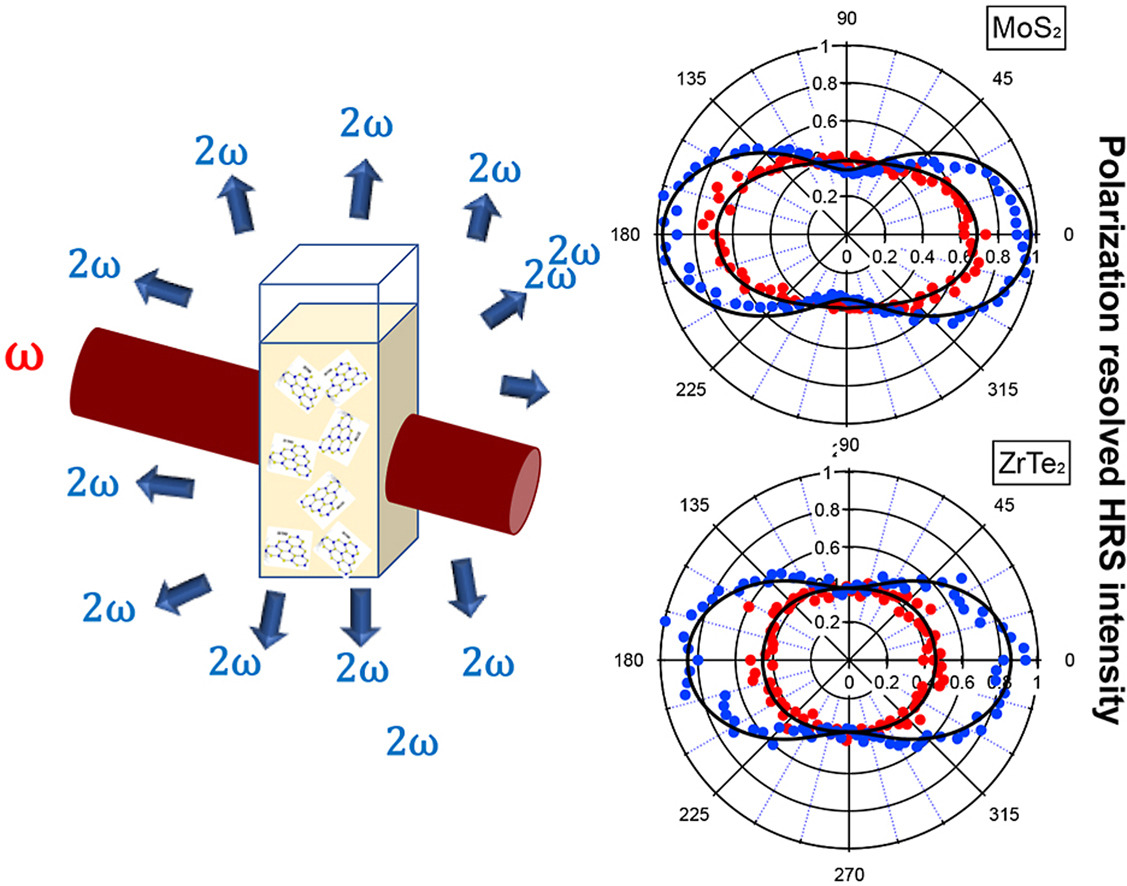
We report the second harmonic scattering experiments from acetonitrile liquid suspensions of two-dimensional metal dichalcogenide nanoflakes,: the semiconducting MoS2 and WS2, the metallic NbS2, and the semi-metallic ZrTe2. Because the study is directly performed in the liquid phase, no symmetry breaking can be attributed to a supporting substrate as it is often the case in the investigation of the second harmonic generation efficiency for these materials. A comparative look of the origin of the nonlinear response using polarization analysis of the hyper Rayleigh scattering intensity is performed. Retardation is clearly exhibited by all nanoflakes considering their average dimensions but remains weak. This is attributed to the non-negligible role played by the nanoflake edges or the presence of surface absorbed polyoxometalates (POMs), in all cases.