2D Thermal Maps Using Hyperspectral Scanning of Single Upconverting Microcrystals: Experimental Artifacts and Image Processing
Abstract
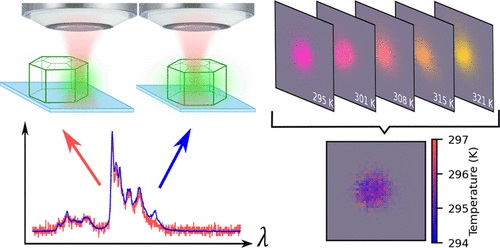
Whereas lanthanide-based upconverting particles are promising candidates for several micro- and nanothermometry applications, understanding spatially varying effects related to their internal dynamics and interactions with the environment near the surface remains challenging. To separate the bulk from the surface response, this work proposes and performs hyperspectral sample-scanning experiments to obtain spatially resolved thermometric measurements on single microparticles of NaYF4: Yb3+,Er3+. Our results showed that the particle’s thermometric response depends on the excitation laser incidence position, which may directly affect the temperature readout. Furthermore, it was noticed that even minor temperature changes (<1 K) caused by room temperature variations at the spectrometer CCD sensor used to record the luminescence signal may significantly modify the measurements. This work also provides some suggestions for building 2D thermal maps that shall be helpful for understanding surface-related effects in micro- and nanothermometers using hyperspectral techniques. Therefore, the results presented herein may impact applications of lanthanide-based nanothermometers, as in the understanding of energy-transfer processes inside systems such as nanoelectronic devices or living cells.