Effective model for nonlinear refraction and extinction coefficients in the presence of stimulated light scattering
Abstract
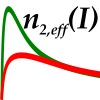
We present in this paper a wave-coupled model (WCM) to describe the effective nonlinear (NL) optical response of transparent materials illuminated by strong light beams in conditions such that stimulated light scattering is relevant. At low intensities, the WCM indicates that the NL scattering behaves similarly to a third- and fifth-order polarization susceptibility. However, at sufficiently high intensities, NL light scattering will lead to highly nonperturbative effective NL refraction and NL absorption coefficients. This is an important remark, given that attempts to explain NL scattering contributions as a perturbative NL response from data obtained at low intensities will become discrepant from the data obtained at high intensities. As an application of the model, we show that the existing divergent interpretations of the carbon disulfide (CS2) NL response in the picosecond and femtosecond regimes by several authors are consistent with the WCM, which indicates a direction for future experiments that may clarify the present controversy.